Last night we arrived in Chennai. After picking up our bags, MrsM’s parents were waiting outside to pick us up with a driver. He was nowhere to be found, and turned out sleeping in his car. It took multiple calls from his boss to wake him up.
After loading everything into the large car I sat in the front and got ready to fasten my seat belt when the driver told me: “No, no use, it’s dusty!”. I was stunned, mumbling somethin, “Oh, we rather die…”. And MrsM commented that believing in reincarnation sometimes works in your favor. So true. Different country, different customs. Needless to say we made it home safely. Statistics…
All posts by admin
Halloween – again!
A friend of ours believes that Halloween once a year isn’t enough. So they made their son’s birthday party another Halloween bash in the midst of January. More than 50 kids came. Little Ro went as Darth Wader. See for yourself (sorry – can’t figure out how to rotate this pic in this stupid tool – crazy layout goes well with the crazy event -enjoy!):

Safe Driving
Today I’d like to share some advice for being a safer driver on the road. Having driven for almost 20 years now without any major accident (of course, I’ll have one tomorrow now) there have been really three major strategies that have kept me safe:
1) Keep your distance
2) Take turns slowly
3) Anticipate – Guess other driver’s intentions
If you limit distractions while at the wheel (no phones, no eating, no turning around to the passengers, no fiddeling with the GPS) adhering to these three very basic principles will make you a safer driver.
Another strategy I’m following comes from analyzing the common case – i.e. your daily commute. If you’re spending 70% of your annual driving on the same stretch of the road, it’s worth analyzing it. Try to think about where the hotspots for accidents are and be alert, when you pass them.
And then there will be the day where you still learn something new … (like yesterday, when that car in front of me slowed unexpectedly to make a legal U-turn, where I haven’t seen a car turning ever before – not in seven years! Anti-lock brakes are wonderful.)
Obama Inauguration Speech Tue Feb 20th 2009
My fellow citizens:
I stand here today humbled by the task before us, grateful for the trust you have bestowed, mindful of the sacrifices borne by our ancestors. I thank President Bush for his service to our nation, as well as the generosity and cooperation he has shown throughout this transition.
Forty-four Americans have now taken the presidential oath. The words have been spoken during rising tides of prosperity and the still waters of peace. Yet, every so often the oath is taken amidst gathering clouds and raging storms. At these moments, America has carried on not simply because of the skill or vision of those in high office, but because We the People have remained faithful to the ideals of our forbearers, and true to our founding documents.
So it has been. So it must be with this generation of Americans.
That we are in the midst of crisis is now well understood. Our nation is at war, against a far-reaching network of violence and hatred. Our economy is badly weakened, a consequence of greed and irresponsibility on the part of some, but also our collective failure to make hard choices and prepare the nation for a new age. Homes have been lost; jobs shed; businesses shuttered. Our health care is too costly; our schools fail too many; and each day brings further evidence that the ways we use energy strengthen our adversaries and threaten our planet.
These are the indicators of crisis, subject to data and statistics. Less measurable but no less profound is a sapping of confidence across our land – a nagging fear that America’s decline is inevitable, and that the next generation must lower its sights.
Today I say to you that the challenges we face are real. They are serious and they are many. They will not be met easily or in a short span of time. But know this, America – they will be met.
On this day, we gather because we have chosen hope over fear, unity of purpose over conflict and discord.
On this day, we come to proclaim an end to the petty grievances and false promises, the recriminations and worn out dogmas, that for far too long have strangled our politics.
We remain a young nation, but in the words of Scripture, the time has come to set aside childish things. The time has come to reaffirm our enduring spirit; to choose our better history; to carry forward that precious gift, that noble idea, passed on from generation to generation: the God-given promise that all are equal, all are free, and all deserve a chance to pursue their full measure of happiness.
In reaffirming the greatness of our nation, we understand that greatness is never a given. It must be earned. Our journey has never been one of short-cuts or settling for less. It has not been the path for the faint-hearted – for those who prefer leisure over work, or seek only the pleasures of riches and fame. Rather, it has been the risk-takers, the doers, the makers of things – some celebrated but more often men and women obscure in their labor, who have carried us up the long, rugged path towards prosperity and freedom.
For us, they packed up their few worldly possessions and traveled across oceans in search of a new life.
For us, they toiled in sweatshops and settled the West; endured the lash of the whip and plowed the hard earth.
For us, they fought and died, in places like Concord and Gettysburg; Normandy and Khe Sahn.
Time and again these men and women struggled and sacrificed and worked till their hands were raw so that we might live a better life. They saw America as bigger than the sum of our individual ambitions; greater than all the differences of birth or wealth or faction.
This is the journey we continue today. We remain the most prosperous, powerful nation on Earth. Our workers are no less productive than when this crisis began. Our minds are no less inventive, our goods and services no less needed than they were last week or last month or last year. Our capacity remains undiminished. But our time of standing pat, of protecting narrow interests and putting off unpleasant decisions – that time has surely passed. Starting today, we must pick ourselves up, dust ourselves off, and begin again the work of remaking America.
For everywhere we look, there is work to be done. The state of the economy calls for action, bold and swift, and we will act – not only to create new jobs, but to lay a new foundation for growth. We will build the roads and bridges, the electric grids and digital lines that feed our commerce and bind us together. We will restore science to its rightful place, and wield technology’s wonders to raise health care’s quality and lower its cost. We will harness the sun and the winds and the soil to fuel our cars and run our factories. And we will transform our schools and colleges and universities to meet the demands of a new age. All this we can do. And all this we will do.
Now, there are some who question the scale of our ambitions – who suggest that our system cannot tolerate too many big plans. Their memories are short. For they have forgotten what this country has already done; what free men and women can achieve when imagination is joined to common purpose, and necessity to courage.
What the cynics fail to understand is that the ground has shifted beneath them – that the stale political arguments that have consumed us for so long no longer apply. The question we ask today is not whether our government is too big or too small, but whether it works – whether it helps families find jobs at a decent wage, care they can afford, a retirement that is dignified. Where the answer is yes, we intend to move forward. Where the answer is no, programs will end. And those of us who manage the public’s dollars will be held to account – to spend wisely, reform bad habits, and do our business in the light of day – because only then can we restore the vital trust between a people and their government.
Nor is the question before us whether the market is a force for good or ill. Its power to generate wealth and expand freedom is unmatched, but this crisis has reminded us that without a watchful eye, the market can spin out of control – and that a nation cannot prosper long when it favors only the prosperous. The success of our economy has always depended not just on the size of our Gross Domestic Product, but on the reach of our prosperity; on our ability to extend opportunity to every willing heart – not out of charity, but because it is the surest route to our common good.
As for our common defense, we reject as false the choice between our safety and our ideals. Our Founding Fathers, faced with perils we can scarcely imagine, drafted a charter to assure the rule of law and the rights of man, a charter expanded by the blood of generations. Those ideals still light the world, and we will not give them up for expedience’s sake. And so to all other peoples and governments who are watching today, from the grandest capitals to the small village where my father was born: know that America is a friend of each nation and every man, woman, and child who seeks a future of peace and dignity, and that we are ready to lead once more.
Recall that earlier generations faced down fascism and communism not just with missiles and tanks, but with sturdy alliances and enduring convictions. They understood that our power alone cannot protect us, nor does it entitle us to do as we please. Instead, they knew that our power grows through its prudent use; our security emanates from the justness of our cause, the force of our example, the tempering qualities of humility and restraint.
We are the keepers of this legacy. Guided by these principles once more, we can meet those new threats that demand even greater effort – even greater cooperation and understanding between nations. We will begin to responsibly leave Iraq to its people, and forge a hard-earned peace in Afghanistan. With old friends and former foes, we will work tirelessly to lessen the nuclear threat, and roll back the specter of a warming planet. We will not apologize for our way of life, nor will we waver in its defense, and for those who seek to advance their aims by inducing terror and slaughtering innocents, we say to you now that our spirit is stronger and cannot be broken; you cannot outlast us, and we will defeat you.
For we know that our patchwork heritage is a strength, not a weakness. We are a nation of Christians and Muslims, Jews and Hindus – and non-believers. We are shaped by every language and culture, drawn from every end of this Earth; and because we have tasted the bitter swill of civil war and segregation, and emerged from that dark chapter stronger and more united, we cannot help but believe that the old hatreds shall someday pass; that the lines of tribe shall soon dissolve; that as the world grows smaller, our common humanity shall reveal itself; and that America must play its role in ushering in a new era of peace.
To the Muslim world, we seek a new way forward, based on mutual interest and mutual respect. To those leaders around the globe who seek to sow conflict, or blame their society’s ills on the West – know that your people will judge you on what you can build, not what you destroy. To those who cling to power through corruption and deceit and the silencing of dissent, know that you are on the wrong side of history; but that we will extend a hand if you are willing to unclench your fist.
To the people of poor nations, we pledge to work alongside you to make your farms flourish and let clean waters flow; to nourish starved bodies and feed hungry minds. And to those nations like ours that enjoy relative plenty, we say we can no longer afford indifference to suffering outside our borders; nor can we consume the world’s resources without regard to effect. For the world has changed, and we must change with it.
As we consider the road that unfolds before us, we remember with humble gratitude those brave Americans who, at this very hour, patrol far-off deserts and distant mountains. They have something to tell us today, just as the fallen heroes who lie in Arlington whisper through the ages. We honor them not only because they are guardians of our liberty, but because they embody the spirit of service; a willingness to find meaning in something greater than themselves. And yet, at this moment – a moment that will define a generation – it is precisely this spirit that must inhabit us all.
For as much as government can do and must do, it is ultimately the faith and determination of the American people upon which this nation relies. It is the kindness to take in a stranger when the levees break, the selflessness of workers who would rather cut their hours than see a friend lose their job which sees us through our darkest hours. It is the firefighter’s courage to storm a stairway filled with smoke, but also a parent’s willingness to nurture a child, that finally decides our fate.
Our challenges may be new. The instruments with which we meet them may be new. But those values upon which our success depends – hard work and honesty, courage and fair play, tolerance and curiosity, loyalty and patriotism – these things are old. These things are true. They have been the quiet force of progress throughout our history. What is demanded then is a return to these truths. What is required of us now is a new era of responsibility – a recognition, on the part of every American, that we have duties to ourselves, our nation, and the world, duties that we do not grudgingly accept but rather seize gladly, firm in the knowledge that there is nothing so satisfying to the spirit, so defining of our character, than giving our all to a difficult task.
This is the price and the promise of citizenship.
This is the source of our confidence – the knowledge that God calls on us to shape an uncertain destiny.
This is the meaning of our liberty and our creed – why men and women and children of every race and every faith can join in celebration across this magnificent mall, and why a man whose father less than sixty years ago might not have been served at a local restaurant can now stand before you to take a most sacred oath.
So let us mark this day with remembrance, of who we are and how far we have traveled. In the year of America’s birth, in the coldest of months, a small band of patriots huddled by dying campfires on the shores of an icy river. The capital was abandoned. The enemy was advancing. The snow was stained with blood. At a moment when the outcome of our revolution was most in doubt, the father of our nation ordered these words be read to the people:
“Let it be told to the future world…that in the depth of winter, when nothing but hope and virtue could survive…that the city and the country, alarmed at one common danger, came forth to meet [it].”
America. In the face of our common dangers, in this winter of our hardship, let us remember these timeless words. With hope and virtue, let us brave once more the icy currents, and endure what storms may come. Let it be said by our children’s children that when we were tested we refused to let this journey end, that we did not turn back nor did we falter; and with eyes fixed on the horizon and God’s grace upon us, we carried forth that great gift of freedom and delivered it safely to future generations.
Flying to the Hangar
Yesterday I did something silly I wanted to do for a long time. After a day of towing with the 260hp Pawnee and filling up at our gas station I flew it back to the hangar (instead of taxiing). The distance from the gas station to the hangar is roughly 1000 ft so taking off and landing in that distance was tight. But the northerly winds allowed for a short take off roll, and relatively low speeds over the runway. So I managed a short hop, landed, cut power and taxied with the remaining momentum right in front of the hangar box where the plane gets parked. It’s awesome to feel so in sync with the plane…
Stock Buybacks
This is going to be a rant. It’s about stock buyback programs. Stock buybacks are these great programs that are loved and demanded by MBA suits and finance folks to trick public companies to spend their money on guess what: buying themselves! Now think about this for a moment: The company that has generated a hard earned profit, tries to put that money to work. And the best way they can come up with is buying more of its own. Cmon’ you’re kidding right? It isn’t investing in more R&D, thinking up new products, it’s not investing in more aggressive marketing of existing products, it’s not investing in the sales force, it’s not buying other companies to grow new business, it’s not paying bonuses to high achieving employees, it’s not spending on shoring up their employees retirement plans. No, it’s spending on shareholder value, the reduction of dilution in stocks to increase earnings per share. And why does this work so beautifully? Because influential investment funds own ridiculously large amounts of the publicly traded stocks and are benefiting disproportionally from such a buyback. “Just give me that money you’re having!” But it gets better: Not only doesn’t have the company a good ideas how to grow its business faster than the competition, it does this kind of buyback usually during good times, when stock prices are high. Granted, nobody can predict the stock price and cost averaging takes care of some inefficiencies, but shouldn’t this kind of investment then continue during bad times, when the stock prices are deflated? You would think. Price averaging works that way. But NO, suddenly cash preservation takes precedence and stock purchases stop during bad times. Latest example: Intel. They’ve been buying their stock all three quarters long, until business turned really sour in Q4 of 2008. So they stopped buying back stock. The stock is 48% down since it’s high in 2008. Not that I think preserving cash is a bad thing during these times. But it’s more important to invest the money in new products or business (you can’t save yourself out of a recession, you need to invest!) to emerge stronger when the next cycle starts. I’m not suggesting Intel isn’t doing that. It is. But it’s also having a stock buyback program because it fell slave to the fund managers. I’m convinced that stock buybacks weren’t a good idea to spend your money on in first place. Not in good times, and not in bad times. If you can’t find management to grow the business faster than investing in their own stock, get rid of them, is what I say. They’re out of ideas or have fallen slaves to their investors. But IMO the reason we have so many buyback programs is that that’s really all the MBA suits understand of the companies’ underlying businesses they invest in. And it’s the fastest way known to them to extract money. It’s easy to ask for, especially if you own huge chunks of stocks. So give me more of your hard earned money!
Watching Rohan play
These days, watching Rohan when he’s not sick is a really great experience. With the scientific curiosity and the knowledge of dog behavior and how to train them it is highly interesting to watch Rohan play. At the age of 8 months, his motoric system is still in the development stage – sensor feedback is almost non-existent, which makes his movements very coarse (German: Grobmotoriker). Also he thinks in straight lines. He’s very careful to navigate the labyrinth of chairs under the breakfast table, knows to lower his head when crawling sideways under the chairs with a lower sidebar. If he can’t reach his toy in a straight line though, he rather gives up than searching for a non-direct route – just like dogs, he thinks in straight lines. On a different game he tried to reach a particular toy in his toy chest, that he could touch on the top surface, but couldn’t grab to lift it up. After having tried for five or six times to no avail, he pulled the whole box towards him in a 45 degree angle to have more range in the box and move the toy closer to him (it rolled inside the box). Then he continued with his previous and now successful strategy to lift it out of the box. You should have seen his face holding the toy up in the air looking at me! This was very touching.
Texas Soaring Weather
After having flown for five years in Texas weather I want to share some thoughts on the soaring conditions in Austin, Central Texas. You hear a lot of stories about the amazing weather conditions in Texas and data from the World Gliding Championships in Uvalde and Marfa confirm the common perception of our outstanding soaring conditions in Texas.
Having sampled the weather myself over the last couple of years I have to say though while good, the conditions aren’t as homogeneous as one might think. There’s a reason for the local saying: Don’t like the weather? Check back in 10 minutes.
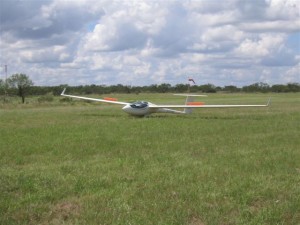
Thermals usually coexist with high winds conditions and form in warm air advection with winds shifting clockwise with altitude. In Germany the most comparable weather situation would be a high pressure sytem over the Balkan generating south-easterly winds. Winds play a major role in how the day will develop. We usually start with an overcast cloud layer in the morning from the sea breeze. With winds from 150-170 degrees at 5-15kts you can expect the day to develop into great soaring conditions. I’ve woken up to rain out of an overcast sky. By the time I had reached the airfield the sky started to clear up and an hour later I was on my way for a 500km task, which I finished averaging 108km/h. Cloud base will start low at about 3-4000ft MSL and will rise over the day to 7000ft AGL on a good, 9000ft on an exceptional day. Our airfield elevation is 1200ft. Forecasted maximum temperatures are usually directly proportional to cloud base heights. Due to the warm advection nature of the air mass, temperature is king and thermal activity rarely starts before 11:30a. Lift weakens significantly after 5p and lasts until 7pm on a good day in August, until 7:30p on an exceptional day (usually with a disturbance – mostly high level troughs). Thanks to the winds we often enjoy cloud streets that line up north-south. Unfortunately the nice looking clouds aren’t all very reliable and present wide variations of climb rates while not looking very different from each other. Due to the warm air advection, the thermals are usually quite turbulent and centering lift is a challenging task. Big shifts in wind directions with altitude (wind sheer) within the boundary layer prevent the effective use of the lower altitude band – usually below 4000 AGL. Convection in warm air needs a long time (think height) to structure, so low saves are rare and not recommended. Staying high becomes a priority. Surprisingly the wind is no help in identifying otherwise obvious thermal triggers on the ground. Thermals seem to develop almost randomly and disconnect from the ground quickly. (I haven’t tried our coal fired power plant east of Austin yet…)
Landing out on a field in west Texas can be challenging for the vast size of the undeveloped countryside. Big ranchlands with unimproved terrain, formed of rocks, bushes and rolling hills dominate the area west of Austin, known as the Texas Hill Country. Only few agriculturally used areas exist. Private airstrips are very common although not always suitable for landing with a glider. The airport density is much lower compared with Germany. While cloud base is usually 1000-2000ft higher in the west than at home base, so is the terrain. So care must be taken to stay high and work the strong thermals, instead of getting low, fighting with unstructured lift, dealing with unreliable ground triggers and dealing with difficult to land terrain. More than once during my many flights to the west have I turned 90 degrees off course, just to have the next landing field in glide range. Needless to say, this is a frustrating experience.
On a good day the clouds show about a 2/3 likelihood of lift. During the many times when a high level trough is passing over Texas, we have lots of old inactive, though promising looking clouds in the sky. Distinguishing these old leftover clouds (called Leichen in German) from newly forming ones poses a major challenge to the beginner. If you decide to follow the clouds instead of the sun or your intuition, you’re in for a wild ride – usually getting disappointed three times in a row before being threatened to land. Working your way out of a ditch like that on a long flight can be a nerve wrecking experience. In 2006 I’ve spent 40 minutes digging myself out of a hole at the second turn point of a 750km FAI task. When I was back under cloud base, I was 20min behind schedule. Fortunately the day held up and I made it home nevertheless. It helps to observe if the big clouds form sisters close by. If you see a small Cu forming next to the big one, the large cloud is usually dead – unfortunately the sister isn’t much of good lift either, so you better start looking somewhere else.
Open class gliders with high wing loadings have a definite advantage in these conditions. The superior glide performance allows them to chain the weak, often unstructured and turbulent lift along their flight path and to stop only for the best thermals. Experts like Ron Tabery have flown using this style for hundreds of miles without having to circle. The peak climb rate on a good day often exceeds 10kts (5m/s). So being able to restrict yourself to usage of these strong thermals results in extremely high average speed. The speeds of tasks flown in the worlds and the recurring regional 10 competition which often exceed 80 mph are a testament to that.
Texas is located fairly south when compared with central Europe. Austin is actually close to the same latitude as Cairo in Egypt. While we don’t have the sand deserts of northern Africa (there is a stone desert in the far west of Texas in the Big Bend area of the state) we have the same length of day as Cairo. In the summer the days are shorter than the days in central Europe, in the winter they are longer (relatively speaking). This limits the amount of energy during the day and restricts the maximum distance that can be flown. We rarely get days with thermal activity durations exceeding 8 hours. While the longest day occurs on June 20th, July and August are statistically the best months to fly big tasks in Texas. September still offers great conditions albeit 1 hour shorter days demand shorter tasks. With the predominant warm air advection, high maximum temperatures are key for a good day. When we hit the 100’s (42+ degrees Celsius) the conditions are usually pretty good. Flying high under cloud base is the natural thing to do in this hot weather. The challenge is to keep your cool while on the ground before launching. Assembling the glider, and filling water ballast in these temperatures leaves you exhausted and soaked in sweat. Many times I’ve found myself demotivated to fly after having run around in the morning sun for 1.5 hrs. Keeping the glider assembled from the night before can help tremendously with the pilot’s energy management and an upbeat attitude for the day’s task.
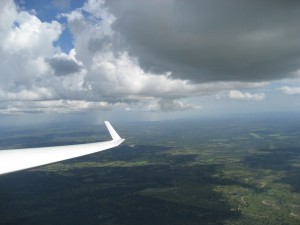
Clouds are paramount for fast speed tasks and we fly almost exclusively under partly cloudy skies when attempting cross country flights. As long as the winds keep coming from the 150-170 degree angle in the lower levels, clouds are guaranteed, as a constant stream of moisture coming from the Gulf of Mexico is transported inland. Flying west, you will experience a rising cloud base over rising terrain. Unfortunately, flying west the cloud cover usually decreases from 2-3/8 Cu to 1-2/8 Cu before conditions turn completely blue. This is due to the fact that the moisture stream from the gulf is losing its influence in the west and more continental and drier air from northern Mexico is transported into Texas.
On a good day the cloud cover decreases to 1/8 at Junction on I-10 and tapers out to blue conditions around Ozona. On a few rare occasions clouds continue further west but be warned that this is not normal and you should expect some weather system change (either a trough moving in, a front approaching from NW or a change to very easterly to North easterly winds (cold air advection) . In any of these cases you’re traversing a weather boundary which can get you into trouble. Remember that retrieves from that area will take days.
The importance of the right wind direction for good and homogeneous conditions can’t be overstated. What separates a good from a bad day can be as little as a 10-20 degree shift in wind direction. So if the wind shifts to 150 or less over the day you can expect Thunderstorms to develop in a line usually starting along I-10 at or south of San Antonio. Watch this development carefully over multiple days, as this feature is usually moving in a multi-day pattern. If you’re unlucky and have chosen the last turn-point too far south east you’ll be forced to cancel the task, as the Thunderstorms usually linger into the night. If you get lucky though, you can use the convergence line from the sea breeze to improve your average speeds significantly.
So what’s so great about Texas soaring conditions in short?
If conditions are great in July/August you can fly tasks of up to 800km in 15m class gliders, over 1000km FAI in open class.
The squall lines make for an impressive display of Cu and Cb clouds – many times with showers. Playing around with my glider under these monsters is just plain fun (until you get told off by lightning). The Cu skies in Texas look like a picture from soaring paradise.
The cloud streets are a hoot to fly, when performing Yo-Yo tasks aligned with the wind.
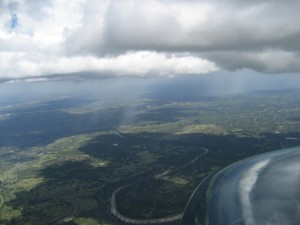
The widely unpopulated areas of west Texas give you a true sense of freedom in the sky, while admiring the rough beauty of the land that is mostly untouched by humans.
The absence of any airspace restrictions worth mentioning in West Texas makes it the perfect playground for gliders.
Flying at cloudbase provides a most welcome cool down during the unforgiving hot Texas summers – I’ve never enjoyed freezing barefoot and only wearing a shirt at 12 000ft under a cloud in rain so much.
So while central Texas is maybe lacking a little bit the excitement from low level mountain flying or low altitude flying over easily landable areas (you can do that closer to the coast) it provides plenty of lift for fast soaring adventures over breathtaking sceneries.
Connecting with Germans
Recently I’ve tried to find more Germans in Austin to connect and network with. For that reason I’ve joined the local German ex-patriate group that meets once a month at a local bar. The other day I drove out of our neighborhood (which is pretty big with 2600 houses, almost a village by itself) when I saw an Audi A4 with a German D stuck to its bumper. At the red light at the exit of the neighborhood I rolled down my window and hollered over. After a second of hesitation the Audi’s window also lowered and we were able to exchange a few words before the light turned green. During those seconds I learned that he was indeed originally from Germany as I am and that he lives on street X in the neighborhood. While suggesting that we should have a couple of beers together sometimes, the light turned green and we each went our way.
The next day I went online and looked up the publicly available house owner data of that street and looked for a German sounding name. Mr Meier (name changed) was easily identified and I used his name for a search with LinkedIn, a professional networking community. Sure enough I found him working for another high-tech company in town. So I contacted him in turn through this website. After the exchange of a couple of emails we met yesterday in person the first time. Quite exciting – from a bumper sticker to a new neighborhood friend.
America is really great in that way. Connecting with strangers isn’t considered strange at all. Of course the privacy aspect of this story is somewhat is scary.
What I like about Austin
Do you want to know what I really like about Austin? It’s the weather in winter. Today I had lunch sitting outside with temperatures around 70F/(~21C). After two days of rain and fairly cold weather (40ies/~5C), we’re back to blue skies, calm winds and warm temperatures. With the low standing sun, the bright light is just amazing. January and February have been my favorite months over the last couple of years. Many times it stayed dry for multiple weeks during this time. Of course in summer the lakes are great and soaring can be just awesome in July/August, but temperetures are much less enjoyable (40C). Many people seem to agree, judging by the inflow of people from colder states from the north, or more expensive regions at either coast. Austin’s economy is still humming along nicely, although at a somewhat slower pace than 2007 and I’m not claiming we’re shielded from the national and global financial crisis. It’s just more managable down here…